

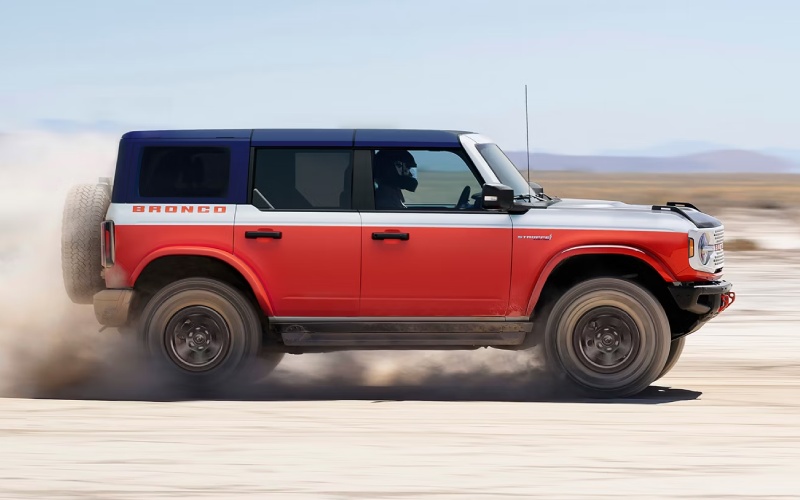
Lasco Ford - Does the 2026 Ford Bronco or the 2026 Jeep Wrangler feel calmer on daily drives and more agile on trails near Brighton, MI?
When shoppers weigh a 2026 Ford Bronco® against a 2026 Jeep® Wrangler, one of the first questions we hear is simple: which SUV feels calmer on daily drives and more agile on trails, especially around Brighton, MI, where routes can swing from I-96 to dirt two-tracks in a single afternoon? It’s a fair ask, because both are icons with serious hardware. The difference shows up in how each vehicle helps you manage the small, constant decisions that make driving either relaxing or tiring over time.
On pavement, the Bronco’s available HOSS (High-Performance Off-Road Stability Suspension) systems do quiet work. Even in non-Raptor trims, HOSS tuning helps the body settle quickly after sharp imperfections, which is exactly what you want when Old US-23 turns patchy or you cross into a coarse subdivision surface. Add up to seven G.O.A.T. Modes® (Goes Over Any Type of Terrain), and throttle and shift logic respond to changing conditions without you micromanaging. Wrangler counters with a classic solid-axle setup that excels at articulation and rock work, and there’s no argument that Rubicon models are formidable where traction is scarce. But during the other 90 percent of life—merging, lane changes, curb cuts—the Bronco’s damping and drive modes feel more cohesive, keeping the cabin calm and your attention where it belongs.
Trail agility where it counts
The pivot-point many drivers notice off-road is Bronco’s Trail Turn Assist. On tight, tree-lined paths common to state recreation areas, it helps the Bronco carve around obstacles with a noticeably smaller turning radius. Pair that with the available 360-Degree Camera’s off-road views, and you see not just the rocks ahead but the branches and stumps you’d otherwise guess at. Wrangler offers a forward TrailCam on select trims, which is useful, but the all-around visibility advantage on Bronco reduces those hit-the-brakes moments that break your flow during a long trail day.
Another underrated point is mirror placement. Both vehicles let you pull the doors for open-air days, but the Bronco’s cowl-mounted mirrors stay put, which means rearward visibility doesn’t vanish when the doors are in your garage. On Brighton-area errands or a quick stop on Grand River Avenue, that detail removes a mental tax—you spend less time double-checking blind spots and more time enjoying the drive. Wrangler owners often add accessory mirrors, but it’s a workaround rather than a built-in solution.
Everyday ease, trail-ready by design
Inside, the Bronco leans into easy cleanup and simple operation. Available marine-grade vinyl and washable floors with drains make short work of sandy shoes after a morning at the lake. The 12-inch SYNC 4 screen is straightforward, wireless Apple CarPlay® and Android Auto™ are standard, and the menus put trail tools a tap or two away. Uconnect® 5 in the Wrangler has a modern interface and an available 12.3-inch display, and Jeep fans will feel at home quickly. Still, the Bronco’s control layout—rubberized, gloved-hand-friendly switches and integrated accessory points—makes it simpler to kit out and simpler to run when you’re bouncing between Brighton-area errands and weekend trail plans.
Power choices reflect those use cases. Bronco offers a 2.3L EcoBoost® with an available 7-speed manual for those who want a crawler gear and a direct, mechanical feel; an available 2.7L EcoBoost V6 for easy torque; and, if you’re chasing dunes, the Bronco Raptor’s 418-hp 3.0L EcoBoost V6. Wrangler’s 3.6L Pentastar® V6 and 2.0L Turbo I-4 are proven and pair with a 6-speed manual or 8-speed automatic. If your days mix school runs, a quick jog down Whitmore Lake Road, and an after-work detour onto gravel, Bronco’s 10-speed automatic, G.O.A.T. Modes®, and HOSS damping create a smoother, more adaptable rhythm.
Comparison takeaways drivers ask about most
- Door-off visibility: Bronco’s cowl-mounted mirrors stay put when doors are removed; Wrangler’s mirrors leave with the doors unless you add accessories.
- Low-speed trail finesse: Bronco’s Trail Turn Assist and 360-Degree Camera reduce three-point turns and guesswork around obstacles.
- Day-to-day calm: HOSS suspension tuning and drive modes keep Bronco composed across patched pavement and expansion joints, easing fatigue.
Of course, both SUVs can be built for serious trail commitment—factory 35-inch tire packages, lockers, and armor are available from each brand. What separates Bronco in real life is how much of its capability you can use, effortlessly, between those bigger weekend plans. It’s less about spec-sheet bragging and more about how you feel at the end of the day.
Frequently Asked Questions:
Do both SUVs offer removable doors and tops?
Yes. Both the Bronco® and Wrangler provide open-air freedom with removable doors and various roof options. Bronco adds a practical twist with cowl-mounted mirrors that preserve visibility when the doors are off.
Which one has better camera support off-road?
Bronco offers an available 360-Degree Camera with off-road overlays, offering a full view around the vehicle. Wrangler offers a forward TrailCam on select trims; helpful on the trail but not a full surround view.
If my priority is daily driving comfort, which should I test first?
Start with Bronco. HOSS suspension tuning and the way its drive modes coordinate steering, throttle, and shifts help it feel settled over uneven surfaces common around Brighton, MI. You can still spec it aggressively for the trail without giving up on-road calm.
One last note: while this isn’t a price conversation, ownership support and local expertise always matter. You’ll want a team that knows the trails and the daily routes. That’s where Lasco Ford, serving Grand Blanc, Brighton, and Hartland, can help with guidance on tires, protection, and accessories that match exactly how you drive with a straightforward, helpful approach.
